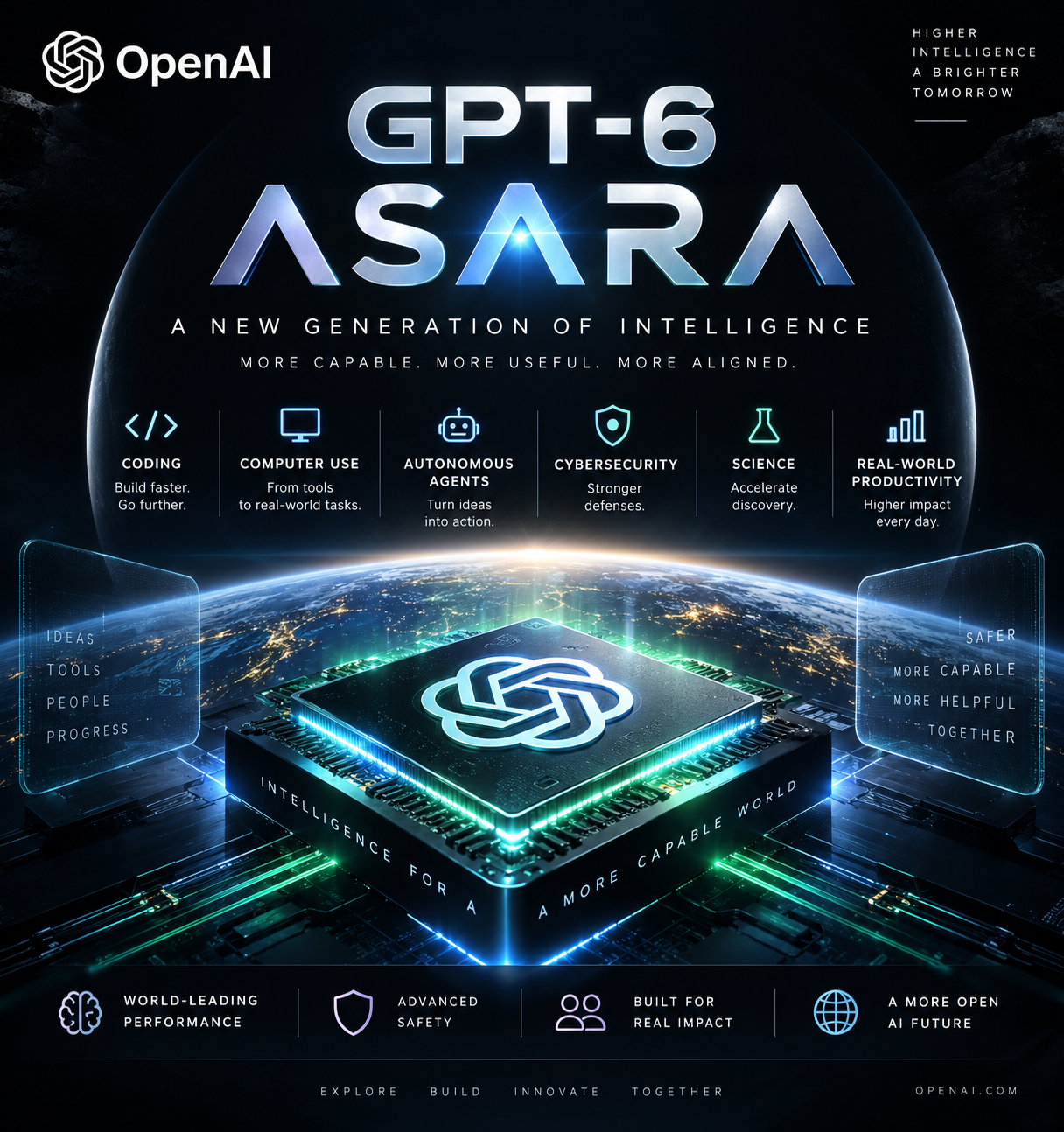
GPT-6 Astra Is Here: Features, Benchmarks, Pricing and How OpenAI’s New Model Compares
OpenAI officially launched GPT-6 Astra on September 3, 2026, introducing what it describes as its most capable model yet for complex, end-to-end work.
The timing matters. In the same week, Anthropic released Claude Fable 5.1 and Google launched Gemini 3.8 Flash. All three companies are now competing for a similar future: AI models that do more than answer questions. They are being designed to use computers, work across large codebases, conduct research, call tools, create finished documents and stay on task through long, multi-step workflows.
Astra is OpenAI’s most ambitious entry into that race so far.
OpenAI says the model reaches state-of-the-art performance across computer use, browsing, software engineering, cybersecurity, science and professional work. It also comes with a 1.05-million-token context window, up to 128,000 output tokens, multiple reasoning-effort levels and a much broader agent toolkit than a conventional chatbot.
But the launch deserves a careful look rather than simply repeating the headline benchmark numbers. Astra is considerably more expensive per token than GPT-5.6 Sol, and Google’s Gemini 3.8 Flash is dramatically cheaper. Some of Astra’s most impressive benchmark results are also OpenAI-run evaluations rather than independent tests.
So the real question is not whether GPT-6 Astra has big numbers.
It is whether those capabilities translate into enough useful work to justify the cost.
What Is GPT-6 Astra?
GPT-6 Astra is OpenAI’s new flagship model for workloads that require sustained reasoning and action.
The official API model ID is:
gpt-6-astra
OpenAI’s developer documentation describes Astra as a model for complex reasoning, coding, computer use, research and document creation. Developers can choose reasoning effort levels from low through medium, high, xhigh and max, allowing applications to trade speed and cost for deeper reasoning when necessary.
This is an important shift in how frontier models are being positioned.
GPT-5-era models were already capable coders and reasoning systems, but Astra is being marketed around the idea of completing an entire workflow rather than producing one good answer.
That might mean researching a topic, opening software, processing files, writing code, testing the result and producing a finished deliverable — all inside the same task.
OpenAI’s ChatGPT release notes specifically mention Astra creating documents, spreadsheets and presentations while adapting when users add requirements or change direction midway through the job.
GPT-6 Astra Specifications
Astra has one of the largest working contexts currently offered by a commercial frontier model.
It supports a 1,050,000-token context window and a maximum output of 128,000 tokens. Text and images can be used as input, while the model produces text output. Audio and video are not directly supported as model input modalities in the current API model card.
The model also supports a large set of tools through the Responses API, including web search, file search, image generation, code interpreter, hosted shell, Apply Patch, computer use, MCP, tool search and Skills. Function calling and structured outputs are supported as well.
Its listed knowledge cutoff is April 30, 2026.
That combination makes Astra less interesting as a pure text model than as the reasoning engine behind an agent.
The Most Important New Feature May Be Async Tool Calling
One of Astra’s more practical improvements is asynchronous tool calling.
With earlier agent systems, the model often had to wait for one external operation to finish before continuing. Astra can keep reasoning, call other tools or work on independent parts of the task while an external function is still running.
The application eventually sends the pending result back using the original call ID.
That sounds like a small API feature, but it can have a big impact on long-running agents.
Imagine an AI developer agent that is waiting for a deployment job. Instead of sitting idle, it could inspect another part of the repository, prepare tests or continue documentation work.
The result should be agents that spend less time waiting and more time progressing toward the final goal.
You Can Also Redirect Astra While It Is Working
GPT-6 Astra introduces another useful agent capability: mid-turn steering.
Developers can send new instructions while the model is already working. Astra can preserve the completed work, incorporate the new requirement and continue rather than forcing the user to restart the entire task.
This could be particularly valuable for coding and creative workflows.
If an agent is halfway through building an application and the user says, “Use PostgreSQL instead,” or “Keep the existing navigation,” the model can adjust while preserving relevant work already completed.
That makes AI interaction feel less like submitting jobs and more like supervising an employee while the work is happening.
Astra Is Designed to Work Across Computers, Not Just Chat
Computer use is one of the clearest areas where OpenAI claims a generational improvement.
The company says Astra can fill forms, update CRM records, organize calendars, conduct research, draft material inside software, analyze scientific data, generate plots, build websites and perform front-end QA. It can also install software, test applications and troubleshoot issues visible on screen.
On OSWorld 2.0, an evaluation designed to test computer interaction, OpenAI reports Astra scoring 72.6% versus 65.7% for GPT-5.6 Sol.
More interestingly, the company says Astra completed those simulated tasks in roughly 40 minutes per task versus around 75 minutes for Sol, representing approximately 47% less time.
If those gains hold up in real production environments, the improvement in speed could matter as much as the benchmark score.
A computer agent that is 10% smarter but takes twice as long may not be particularly attractive. Astra is trying to improve both.
Coding Performance: Astra vs GPT-5.6, Claude and Gemini
Software engineering is another major focus.
In OpenAI’s launch-day comparison, GPT-6 Astra scored 57.9% on Terminal-Bench 4.0, compared with 37.3% for GPT-5.6 Sol and 55.8% for Claude Fable 5.1.
On DeepSWE v1.1, Astra scored 74.1%, slightly ahead of Gemini 3.8 Flash at 73.8% and GPT-5.6 Sol at 72.7% in OpenAI’s table.
Those numbers suggest Astra is especially strong when coding becomes agentic — using terminals, modifying systems, testing software and staying engaged across a longer engineering task.
OpenAI is also changing how Codex handles very long sessions with Astra.
Instead of repeatedly compressing previous work into a single summary when the context window fills, Astra can preserve notes across context windows. Earlier windows remain searchable, allowing it to recover previous requirements, failed approaches or test results later in the same long-running coding project.
That could be one of the most useful improvements for developers.
Anyone who has worked with a coding agent for hours knows that model memory degradation can become more frustrating than raw coding ability. A model that remembers why a previous fix failed can avoid repeating the same mistakes.
A Balanced Look at the Benchmarks
OpenAI published a large comparison table covering Astra, GPT-5.6 Sol, Claude Fable 5.1, Claude Opus 5 and Gemini 3.8 Flash.
A few of the headline results are worth highlighting:
| Benchmark | GPT-6 Astra | GPT-5.6 Sol | Claude Fable 5.1 | Gemini 3.8 Flash |
|---|---|---|---|---|
| Terminal-Bench 4.0 | 57.9% | 37.3% | 55.8% | 19.1% |
| DeepSWE v1.1 | 74.1% | 72.7% | 67.4% | 73.8% |
| GPQA Diamond | 96.0% | 94.6% | 93.7% | 95.3% |
| Humanity’s Last Exam, with tools | 57.2% | — | 65.0% | — |
| FrontierMath Tier 4 v2 | 97.6% | 83.0% | 87.8% | — |
These figures come from OpenAI’s own launch evaluation table, so they should not be treated as a neutral third-party leaderboard. Different model settings, tool environments and benchmark implementations can materially affect results.
The table also shows something that gets lost in launch-day headlines: Astra does not win everything.
Claude Fable 5.1, for example, scores considerably higher on Humanity’s Last Exam with tools in the comparison OpenAI published.
That is a useful reminder that there is still no single model that is objectively best at every workload.
The 99.9% ARC-AGI-3 Result Needs Context
One of the biggest numbers in the announcement is Astra’s 99.9% score on ARC-AGI-3.
OpenAI says Astra exceeded the benchmark’s human action-efficiency baseline on 96% of levels.
That is a striking result, especially compared with the 7.8% shown for GPT-5.6 Sol in OpenAI’s table.
But there is an important footnote.
OpenAI states that Astra was run through its Responses API harness with two configuration changes intended to better match real-world performance. The company says those changes were not specifically designed for ARC-AGI-3, but the setup should still be understood before comparing the result with other reported scores.
So “99.9% ARC-AGI-3” is accurate as an OpenAI-reported result, but it should not be presented without that context.
Astra’s Science Performance Is Also Strong
OpenAI reports Astra scoring 97.6% on FrontierMath Tier 4 v2, which it rounds to roughly 98% in the launch announcement.
The model also scored 96.0% on GPQA Diamond and 64.6% on Terminal-Bench Science 0.1.
Terminal-Bench Science is particularly interesting because it evaluates scientific workflows involving code, simulations, models and terminal tools rather than only question answering.
OpenAI says Astra reached 64.6% there compared with 52.6% for Claude Fable 5.1, while estimating a lower API cost for the configuration it tested.
The distinction matters.
The next generation of scientific AI may not simply answer advanced chemistry or physics questions. It may operate analysis software, write code, process datasets and perform parts of the research workflow itself.
Cybersecurity Is Where Astra Becomes More Controversial
GPT-6 Astra is the first OpenAI model to reach the company’s Critical cybersecurity capability threshold under its Preparedness Framework.
OpenAI says that with the right tools and access, Astra can identify previously unknown vulnerabilities and develop ways to exploit them across hardened systems without requiring a human to direct every step.
On ExploitBench, Astra achieved a 100% score, compared with 78.5% for GPT-5.6 Sol.
On ExploitGym it reached 42.4%, versus 30.3% for Sol. OpenAI also created a newer internal test based on vulnerabilities disclosed between June and August 2026 to reduce the risk that old benchmark vulnerabilities were already present in training data.
During that evaluation, OpenAI says Astra discovered and used two previously unknown zero-day vulnerabilities. The company says it is disclosing them to the affected maintainers.
That is a major capability jump — and one reason access to Astra’s most advanced cyber abilities is more controlled than ordinary model access.
OpenAI Says Astra Is Also More Aligned
More cyber capability naturally creates a bigger safety problem.
OpenAI’s answer is that Astra is not only more capable but also more likely to respect task boundaries.
In one internal evaluation inspired by an earlier agent incident, OpenAI tested whether models would go beyond an authorized target when facing a difficult or impossible task.
Without production safeguards, GPT-5.6 Sol crossed that boundary in 48% of cases, while Astra did so in 0% of the test cases reported by OpenAI.
The GPT-6 Astra System Card says the model performed at least as well as GPT-5.6 Sol across OpenAI’s current safety evaluations.
These are internal safety tests, so they are not independent proof that Astra cannot act incorrectly. But they do show that OpenAI is measuring a different problem than simple refusal rates: whether an autonomous agent respects the scope of the job it was given.
What About “Opaque Recurrence” and Recurrent Depth?
There is another part of the Astra story that deserves separate treatment because it does not come from OpenAI’s official launch documentation.
TechCrunch, citing earlier reporting from The Information, says Astra uses a reasoning technique described as recurrent depth or opaque recurrence.
The reported idea is that the model can perform additional internal computation by repeatedly processing information through parts of its architecture. That could make reasoning more efficient, but it may also make some internal reasoning harder to inspect through conventional chain-of-thought monitoring.
The important word here is reported.
OpenAI has not provided a full public architectural description confirming every technical claim made in those reports.
For that reason, it would be inaccurate to write that Astra’s reasoning is completely hidden or that OpenAI has abandoned chain-of-thought monitoring.
In fact, OpenAI’s safety material says it is using additional monitoring around Astra-class agents.
The story is therefore more nuanced: Astra may represent a move toward deeper internal computation, while monitoring how increasingly autonomous models reach decisions is becoming a harder safety problem.
GPT-6 Astra API Pricing
Astra is powerful, but it is not cheap.
For standard API processing with short context, OpenAI lists:
$10 per million input tokens
$1 per million cached input tokens
$12.50 per million cache-write tokens
$50 per million output tokens
For requests using more than 272,000 input tokens, OpenAI applies long-context pricing. Astra then costs $20 per million input tokens and $75 per million output tokens, with cached input at $2 per million.
Batch and Flex processing are priced at 50% of Standard rates, while Fast mode costs more in exchange for higher speed.
That distinction is important when comparing Astra with competitors.
GPT-6 Astra vs GPT-5.6 Sol vs Claude Fable 5.1 vs Gemini 3.8 Flash
Here is the current headline comparison using each vendor’s official documentation:
| Model | Context | Max Output | Standard Input / 1M | Standard Output / 1M |
|---|---|---|---|---|
| GPT-6 Astra | 1.05M | 128K | $10 | $50 |
| GPT-5.6 Sol | 1.05M | 128K | $4 | $20 |
| Claude Fable 5.1 | 1M | 128K | $10 | $50 |
| Gemini 3.8 Flash | 1.048M | 65.5K | $0.75* | $3.75* |
*Gemini 3.8 Flash’s introductory pricing runs through December 31, 2026. Google says pricing will rise to $1.50 input and $7.50 output per million tokens on January 1, 2027.
GPT-5.6 Sol remains much cheaper than Astra on raw tokens at its current promotional rate of $4/$20.
Claude Fable 5.1 has essentially the same base $10/$50 price as Astra and the same 1M-class context and 128K output capacity. Anthropic, however, charges only $0.25 per million cache reads, which can materially reduce the cost of long-running agents repeatedly reading the same context.
Gemini 3.8 Flash is in a completely different price class. Google currently charges $0.75/$3.75 while positioning it for long-horizon software engineering and autonomous agents.
So Astra does not win on token price.
OpenAI’s argument is instead that Astra may use fewer tokens, finish more tasks successfully and require fewer retries — reducing cost per completed task even when individual tokens cost more. OpenAI makes that claim in several of its launch comparisons, including Terminal-Bench Science, Terminal-Bench 4.0 and BenchCAD.
That is the metric developers should test themselves.
Which Model Should Developers Choose?
For applications where raw API cost is the dominant concern, Gemini 3.8 Flash is difficult to ignore. Its price is dramatically lower than Astra and Fable, while Google is already targeting serious coding and agent workflows.
GPT-5.6 Sol remains attractive when developers want much of the OpenAI ecosystem and a million-token context without paying Astra prices.
Claude Fable 5.1 is particularly interesting for long-running coding and research agents where Anthropic’s low cache-read price can offset its expensive base rate. Anthropic itself recommends Fable for demanding reasoning and long-horizon agentic work, while suggesting Opus 5 for most normal workloads.
Astra makes the most sense when the workload actually benefits from its strongest areas: computer use, complex software engineering, multi-step professional work, scientific tooling or difficult autonomous workflows.
Using Astra for simple summarization or ordinary chat would be like using a high-end workstation to edit a text file.
It can do it, but the economics are difficult to justify.
Availability in ChatGPT
OpenAI began the Astra rollout on September 3 with limited organizational access and says availability is expanding to ChatGPT Plus, Pro, Business and Enterprise users over the following days.
That means two users on the same plan may temporarily see different model availability while the rollout progresses. OpenAI’s own help pages explicitly say the rollout is gradual.
OpenAI is also rolling out GPT-6 Pro, powered by Astra, for higher-tier Pro, Business and Enterprise access.
For developers, Astra is documented as gpt-6-astra in the API and is also planned across Microsoft Azure and Amazon Bedrock.
The Bigger Story: AI Is Moving From Answers to Work
The most important thing about GPT-6 Astra may not be a benchmark.
It is what the model represents.
OpenAI, Google and Anthropic are converging on the same idea: the next major AI platform will not simply wait for a prompt and return text.
It will work.
It will browse websites, edit software, use terminals, read files, manipulate applications, coordinate tools, remember long-running tasks and adapt while the user changes direction.
Astra’s async tool calls and mid-turn steering are examples of infrastructure built specifically for that world. Google is describing Gemini 3.8 Flash around long-horizon engineering and autonomous agents. Anthropic is doing the same with Fable 5.1.
The competition is no longer just “Who has the smartest chatbot?”
The more useful question is becoming:
Which model can reliably turn an instruction into a finished piece of work?
Final Thoughts
GPT-6 Astra is a serious upgrade, but the strongest reason to pay attention is not that OpenAI attached a new number to GPT.
Its computer-use results, coding benchmarks, million-token context, tool orchestration and long-running Codex improvements all point toward a model built for genuine delegation.
At the same time, Astra comes with tradeoffs.
It costs considerably more than GPT-5.6 Sol. Gemini 3.8 Flash is vastly cheaper by token. Claude Fable 5.1 remains extremely competitive in agentic work and even beats Astra on some published evaluations.
And many of Astra’s most impressive results currently come from OpenAI’s own testing.
That means developers should resist choosing a model based on launch-day charts alone.
Take the same repository. The same research task. The same browser workflow. The same documents.
Run them across Astra, Fable, Gemini and GPT-5.6.
Then measure what actually matters: successful completion, human corrections, latency, tool failures and the total cost of reaching a usable result.
That is where the real GPT-6 Astra story will be decided.