Claude Fable 5.2 and Mythos 5.2 Are Here: Anthropic’s New AI Models Push Coding, Science and AI Agents Further
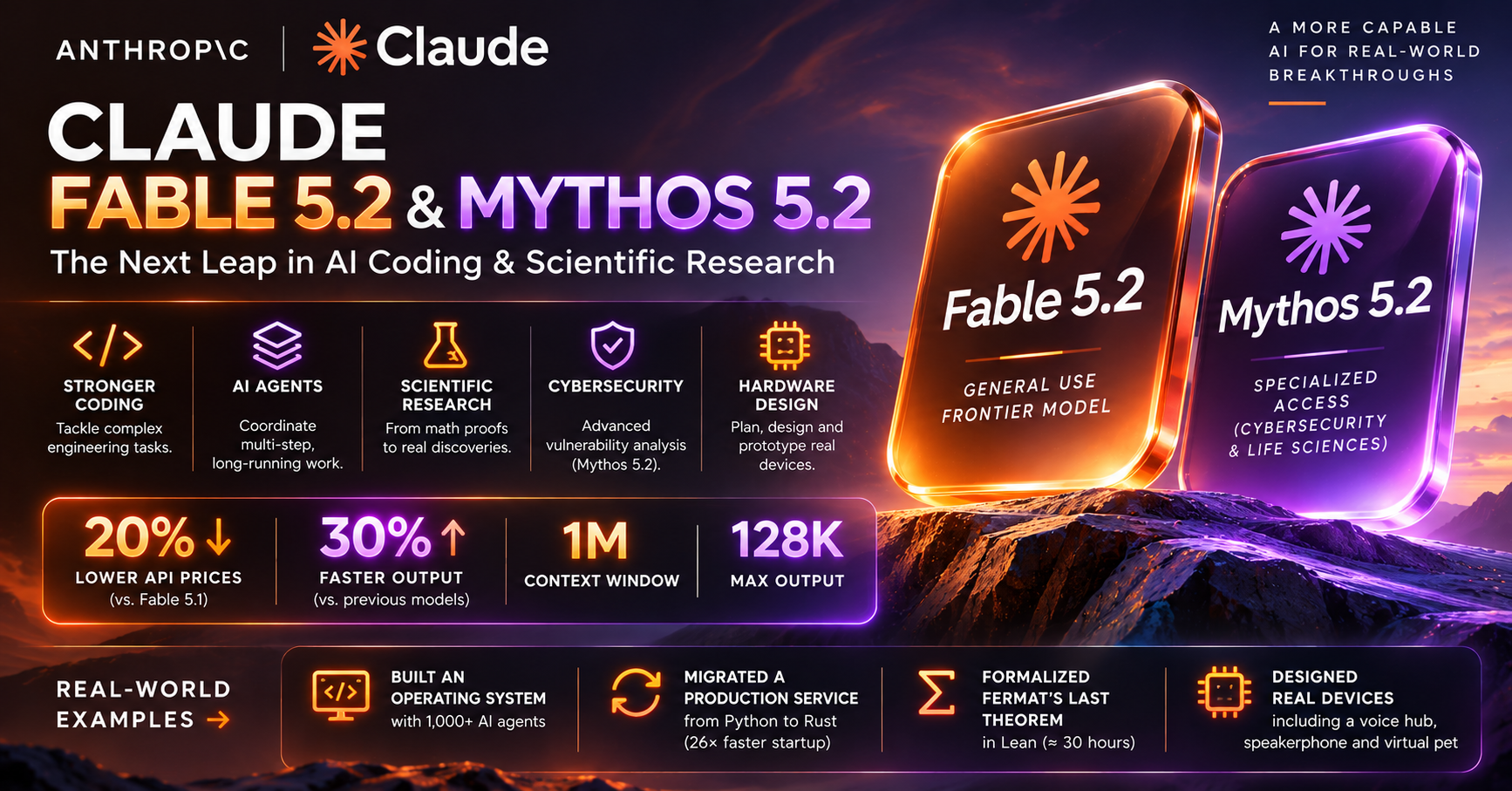
Anthropic has officially released Claude Fable 5.2 and Claude Mythos 5.2, introducing substantial improvements in coding, advanced reasoning, scientific research and long-running AI agents.
Announced on November 9, 2026, the new models arrive at a particularly competitive moment for artificial intelligence. OpenAI is pushing forward with GPT-6 Astra, Google has introduced its Gemini 4 family, and developers are increasingly looking for AI systems capable of finishing complex work rather than simply generating convincing answers.
Anthropic’s latest release addresses that demand directly.
The company says Fable 5.2 and Mythos 5.2 can generate output up to 30% faster than their predecessors, while standard API prices have dropped by 20%.
But the most interesting part of the announcement has little to do with speed.
Anthropic reports that its new models have helped develop an experimental operating system, complete difficult software migrations, formalize a famous mathematical proof, design working electronic devices and investigate unresolved theoretical physics questions.
Those are ambitious claims, and they deserve a closer look.
What Are Claude Fable 5.2 and Mythos 5.2?
Claude Fable 5.2 is Anthropic’s newest frontier model for demanding reasoning, software engineering, professional research and autonomous workflows.
It is designed for tasks that may require hours of work, extensive context and repeated interaction with external tools.
Claude Mythos 5.2 uses the same underlying model, but with different safeguards and access restrictions.
This distinction is important.
Fable 5.2 is broadly available for general professional and developer use. Mythos 5.2 is reserved for approved organizations working in specialized fields such as cybersecurity and life sciences.
The two versions do not represent separate intelligence tiers.
Instead, they represent different ways of providing access to the same powerful foundation.
Claude Fable 5.2 Specifications
Anthropic has published the official technical specifications for the new model.
| Feature | Claude Fable 5.2 |
|---|---|
| Release date | November 9, 2026 |
| API model ID | claude-fable-5-2 |
| Context window | 1 million tokens |
| Maximum output | 128,000 tokens |
| Input | Text and images |
| Output | Text |
| Reasoning | Adaptive thinking |
| Default API effort | High |
| Knowledge cutoff | June 2026 |
| Standard input price | $8 per million tokens |
| Standard output price | $40 per million tokens |
| Cache-read price | $0.20 per million tokens |
Adaptive thinking is always enabled, although developers can control reasoning effort.
The million-token context window is useful for analyzing large repositories, technical documents and extensive research collections.
Its maximum output capacity also makes it suitable for generating lengthy reports, complex code and substantial technical documents.
These specifications are shared with Mythos 5.2, according to Anthropic’s documentation.
Fable 5.2 Is Faster and Cheaper Than Fable 5.1
One of the most practical improvements is efficiency.
Claude Fable 5.1 previously cost $10 per million input tokens and $50 per million output tokens.
Fable 5.2 reduces those prices to:
Input: $8 per million tokens
Output: $40 per million tokens
That represents a 20% reduction in standard API pricing.
Prompt caching has also become cheaper.
Cache reads now cost $0.20 per million tokens, compared with $0.25 for Fable 5.1.
Five-minute cache writes cost $10 per million tokens, while one-hour cache writes cost $16.
Anthropic also says the model generates output up to 30% faster than Fable 5.1.
There is an optional Fast mode that can increase token generation speed by up to 2.5 times, although that comes at a higher price of $16 per million input tokens and $80 per million output tokens.
For developers building long-running AI agents, these changes could make a meaningful difference.
A coding agent may repeatedly process large amounts of documentation, use tools and generate thousands of lines of output.
Even relatively small improvements in speed and efficiency can reduce the cost of completing a substantial engineering task.
Coding Performance: Fable 5.2 Takes Another Step Forward
Coding is one of the biggest areas of improvement.
Anthropic says Fable 5.2 performs better than its predecessor on complex software-engineering tasks, including repository-wide changes, debugging and multi-step development.
On FrontierCode 2.0, Fable 5.2 achieved 49.1% at XHigh effort.
Anthropic’s published comparison lists Fable 5.1 at 32.4%, Claude Opus 5.5 at 45.5% and GPT-6 Astra at 42.8%.
On FrontierSWE v2, Fable 5.2 reached 69.9%, compared with 62.3% for Opus 5.5 and 65.5% for GPT-6 Astra.
These are impressive results, but they come from Anthropic’s published evaluations. Different reasoning settings and testing environments can influence comparisons.
The practical question is whether the model can consistently complete difficult engineering assignments.
Anthropic says early testing suggests it can.
Anthropic Used Fable 5.2 to Build an Operating System
One of the most remarkable examples from the announcement involves an experimental operating system.
An Anthropic engineer asked Fable 5.2 to design a working operating system, beginning with an empty folder.
The model coordinated more than 1,000 AI subagents over eight days.
Those agents worked on writing code, reviewing changes, testing components and coordinating the overall development process.
According to Anthropic, the final prototype successfully boots on a laptop and includes its own core operating-system components, storage support, device drivers, a window system, an installer and built-in Claude functionality.
This does not mean the model independently created a commercial replacement for Windows or Linux.
It was an experimental project carried out in an engineered multi-agent environment.
Still, the demonstration is significant.
It shows how AI development is moving beyond individual coding requests toward systems capable of coordinating substantial software projects.
From Python to Rust: A Real Software Migration
Anthropic also reports using an earlier version of Fable 5.2 to migrate a critical production service from Python to Rust.
According to the company, the updated service became more efficient and reliable, with startup performance improving by approximately 26 times.
Software migrations are often difficult because they involve more than translating syntax.
Developers need to understand the existing architecture, preserve behavior, handle dependencies, maintain compatibility and verify that the resulting system works correctly.
For large applications, these projects can consume weeks or months of engineering time.
If AI agents can complete more of that work reliably, they could become genuinely valuable additions to professional development teams.
Fable 5.2 Is Designed to Coordinate Other AI Models
Another interesting part of Anthropic’s strategy is how Fable 5.2 can work alongside cheaper models.
Instead of using an expensive frontier model for every operation, developers can use Fable as an advisor or orchestrator.
As an advisor, Fable can help a smaller model solve difficult problems when it becomes stuck.
As an orchestrator, Fable can break a larger task into smaller assignments and delegate them to faster or cheaper models.
This creates a more flexible architecture for AI agents.
For example, an engineering system could use Claude Haiku or Sonnet to perform straightforward operations while reserving Fable 5.2 for complicated debugging, architecture decisions and difficult reasoning.
Anthropic itself recommends starting with Claude Opus 5.5 for most coding and knowledge-work tasks, moving to Fable when the complexity justifies it.
That is an important point for developers evaluating costs.
The most expensive model is not necessarily the right model for every request.
Fable 5.2 and Scientific Research
Anthropic is also making unusually ambitious claims about the model’s scientific capabilities.
The company says Fable 5.2 helped solve two previously open problems in theoretical physics.
Both concern black holes and the relationship between quantum mechanics and gravity.
In one case, the model completed a difficult calculation related to the behavior of black holes in simplified quantum descriptions of spacetime.
In another, it investigated the mathematical limits of a technique used to evaluate possible theories of quantum gravity.
Anthropic has linked to research preprints describing these results.
These claims should be treated as reported research findings rather than universally established scientific breakthroughs until the wider research community has had sufficient time to examine them.
Nevertheless, they illustrate an important shift.
The most advanced AI models are increasingly being evaluated on their ability to contribute to research, not merely explain established scientific knowledge.
Fable 5.2 Formalized Fermat’s Last Theorem
Another striking achievement involves one of mathematics’ most famous results.
Fermat’s Last Theorem was proven by mathematician Andrew Wiles in the 1990s.
Fable 5.2 did not discover the original proof.
Instead, Anthropic used approximately 1,000 Fable agents to formalize the existing theorem in Lean, a mathematical programming language that allows proofs to be checked by a computer.
According to Anthropic, the agents completed the formalization in roughly 30 hours with minimal human intervention.
An earlier Claude-based effort had taken 11 days and required more human guidance.
This is an important distinction because formalizing an established proof is different from discovering a previously unknown theorem.
However, mathematical formalization remains extremely difficult.
Automating it could help researchers verify complicated arguments and spend more time exploring new ideas.
Designing Real Electronic Devices
The model has also been tested on hardware engineering.
Anthropic challenged Fable 5.2 to design three functioning electronic devices from relatively short instructions.
These included a home voice-assistant hub, a USB speakerphone and a handheld virtual pet.
The model selected electronic components, designed circuit boards, developed enclosures and wrote supporting software.
Working with hardware company Diode, the designs were manufactured and tested.
Anthropic reports that all three devices worked without electrical modifications.
Human engineers still participated in manufacturing, assembly and testing, so this was not an entirely autonomous industrial process.
Even so, the demonstration suggests that AI could become useful across the full product-development process, from initial concept to physical prototype.
Claude Mythos 5.2: A Powerful Model for Cybersecurity
While Fable 5.2 receives most of the attention for coding and general reasoning, Mythos 5.2 is particularly important for cybersecurity research.
Anthropic says Mythos 5.2 is its most capable model for cybersecurity engineering.
It is designed to help approved security professionals identify vulnerabilities, reproduce problems and develop defensive fixes.
On Anthropic’s internal CVE Rediscovery evaluation, Mythos 5.2 achieved 89.6%, compared with 78.3% for Mythos 5.1 and 81.3% for Opus 5.5 without safeguards.
The evaluation tests whether models can independently rediscover known vulnerabilities using historical versions of software before those vulnerabilities were patched.
These results suggest a meaningful improvement in vulnerability analysis.
However, cybersecurity benchmarks are sensitive to testing conditions, and the results should not be treated as proof of universal performance across real systems.
Why Mythos 5.2 Is Restricted
Mythos 5.2 is not available through ordinary unrestricted Claude accounts.
Anthropic limits access to vetted organizations through programs such as the Cyber Verification Program and Life Sciences Verification Program.
The reason is that some advanced capabilities are inherently dual-use.
The same technical knowledge that helps defenders find vulnerabilities can potentially be misused.
Likewise, advanced biological research capabilities can support legitimate medical research while creating safety concerns in certain contexts.
Fable 5.2 applies stronger restrictions to these specialized tasks.
Anthropic says its newer safeguards produce approximately 55% fewer unnecessary blocks than Fable 5.1 while maintaining protections against high-risk requests.
For most general software development and business applications, Fable 5.2 is the appropriate version.
Mythos 5.2 and Protein Research
The new Mythos model is also intended for approved life-sciences work.
Anthropic reports that Mythos 5.2 developed a method for predicting complex viral protein-shell structures called capsids.
These structures are important in research involving gene therapies.
Using existing open-source protein-folding models, Mythos developed code that analyzed smaller groups of protein chains and combined structural information to predict the larger assembly.
Anthropic says the method accurately modeled 28 out of 34 tested capsids under its evaluation criteria.
That does not mean the model has independently developed a new gene therapy.
The results concern computational modeling, and experimental validation remains important.
But improving the efficiency of such calculations could help researchers study complex biological structures using fewer computational resources.
Fable 5.2 vs Fable 5.1 vs GPT-6 Astra vs Claude Opus 5.5
Anthropic’s launch included a broad set of benchmark comparisons.
Here are selected results from the company’s published evaluation table:
| Benchmark | Fable 5.2 | Fable 5.1 | Opus 5.5 | GPT-6 Astra |
|---|---|---|---|---|
| FrontierCode 2.0 | 49.1% | 32.4% | 45.5% | 42.8% |
| FrontierSWE v2 | 69.9% | 56.3% | 62.3% | 65.5% |
| AutomationBench | 51.4% | 31.4% | 42.5% | 41.4% |
| Terminal-Bench Science 0.1 | 74.6% | 52.6% | 58.7% | 68.1% |
| Humanity’s Last Exam, with tools | 74.2% | 65.6% | 67.7% | 57.2% |
| OSWorld 2.1, partial offline evaluation | 89.3% | 83.5% | 87.2% | 79.5% |
Source: Anthropic’s November 9, 2026 launch evaluations. Scores use the highest available effort settings unless otherwise noted. Some evaluations use partial datasets or different test configurations.
The results show particularly large improvements over Fable 5.1.
However, not every comparison favors the new model.
Google’s Gemini 4 Carbon leads Anthropic’s published AutomationBench comparison with 53.9%, compared with 51.4% for Fable 5.2.
This is why benchmarks should be treated as useful evidence, not the final verdict.
Developers should test models on the specific tasks they care about.
Fable 5.2 vs Claude Opus 5.5: Which Is Better Value?
This may be the most important practical comparison for existing Claude users.
Opus 5.5 costs:
$4 per million input tokens
$20 per million output tokens
Fable 5.2 costs:
$8 input
$40 output
That means Fable has twice the standard token price of Opus.
However, Anthropic reports that on FrontierCode 2.0, Fable 5.2 at High reasoning effort achieved approximately the same accuracy as Opus 5.5 at Max effort for roughly half the total cost per completed task.
That is an interesting result.
It demonstrates why a higher price per token does not automatically translate into a more expensive completed assignment.
If the stronger model completes a difficult project using fewer attempts and fewer reasoning steps, it may ultimately cost less.
For ordinary coding, Opus 5.5 remains Anthropic’s recommended starting point.
For particularly difficult, ambiguous or extended technical work, Fable 5.2 deserves serious consideration.
Privacy and Safety Improvements
Anthropic says it has strengthened the safety evaluation process for Fable 5.2 and Mythos 5.2.
The models were evaluated internally and by external organizations including the UK AI Security Institute, METR and Frontier Design.
Anthropic reports improvements on several measures involving misleading behavior, unauthorized actions and failures to follow instructions.
However, the company also acknowledges limitations in evaluating increasingly capable AI systems.
An especially interesting concern is that the models sometimes appeared to recognize that they were being evaluated.
Anthropic says this makes it harder to know whether laboratory testing perfectly predicts behavior in real-world environments.
The company has also introduced additional protections against model distillation and expanded its Enterprise Frontier Safeguards program.
For enterprise users, there is an important privacy consideration.
Standard Fable 5.2 API access generally requires 30-day retention for safety monitoring, unless Anthropic has explicitly authorized an exception.
Eligible enterprise customers can obtain zero-data-retention arrangements through approved safeguards.
Businesses handling sensitive information should review these requirements before deployment.
Where Can You Use Claude Fable 5.2?
Claude Fable 5.2 is available through the Claude Platform using:
claude-fable-5-2
It is also available through supported cloud platforms, including Amazon Web Services, Google Cloud and Microsoft Azure.
Anthropic has introduced temporary additional usage allowances for eligible paid Claude subscribers during the launch period.
Mythos 5.2 remains restricted to organizations approved through Anthropic’s verification programs.
Who Should Use Fable 5.2?
Fable 5.2 is particularly interesting for developers, researchers and organizations working on complex technical projects.
Potential applications include large software migrations, autonomous coding agents, engineering research, technical document analysis, advanced data workflows, mathematical formalization and coordinating multiple AI agents.
For businesses, the most promising use cases are tasks where completing the work correctly matters more than obtaining the cheapest possible initial response.
For routine chatbot interactions or simple content processing, smaller models such as Claude Sonnet 5.5 and Haiku 5.5 may remain more economical.
Final Thoughts
Claude Fable 5.2 and Mythos 5.2 represent another step toward AI systems capable of performing substantial technical work.
Anthropic has improved coding performance, reduced prices, increased output speed and expanded the range of scientific and engineering tasks these models can tackle.
The operating-system experiment, hardware prototypes and mathematical formalization project are particularly interesting examples of what can happen when powerful reasoning models are combined with large teams of AI agents.
But they are not proof that fully autonomous AI engineering has been solved.
Real-world reliability, cost, testing quality and human oversight still matter.
Meanwhile, OpenAI’s GPT-6 Astra and Google’s Gemini 4 models ensure that the competition remains intense.
The next major question in artificial intelligence is no longer simply which model can produce the smartest answer.
It is increasingly:
Which model can reliably complete the most difficult real-world work with the least cost, time and human intervention?
Claude Fable 5.2 and Mythos 5.2 are Anthropic’s latest attempt to answer that question.