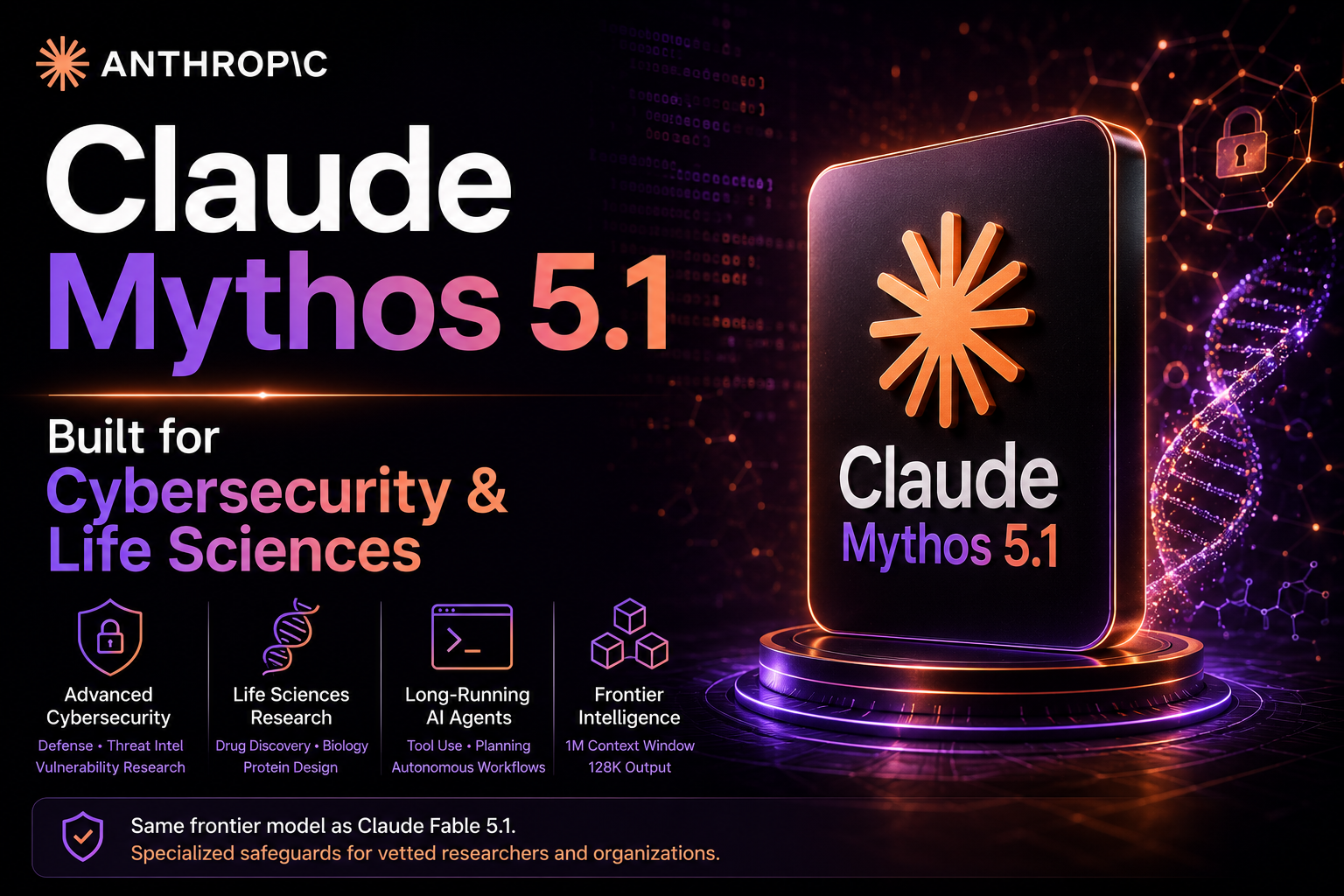
Claude Mythos 5.1: Anthropic’s Most Powerful AI for Cybersecurity and Life Sciences
Anthropic has introduced Claude Mythos 5.1, a specialized version of its newest frontier AI model designed for advanced cybersecurity defense and life-sciences research.
At first glance, the name makes Mythos 5.1 sound like a model sitting above Claude Fable 5.1 in Anthropic’s lineup.
That is not actually what is happening.
Anthropic says Claude Mythos 5.1 and Claude Fable 5.1 use the same underlying model. They share the same core intelligence, reasoning capabilities and long-context architecture.
The key difference is access and safeguards.
Fable 5.1 is the generally available model. Mythos 5.1 uses more permissive safeguards for vetted researchers and organizations working in areas where the standard restrictions could interfere with legitimate cybersecurity or life-sciences research.
That makes Mythos 5.1 one of Anthropic’s most unusual releases yet.
It is not designed for ordinary chatbot users. It is a restricted research model built for some of the most technically demanding—and potentially sensitive—applications of frontier AI.
What Is Claude Mythos 5.1?
Claude Mythos 5.1 launched on September 1, 2026, alongside Claude Fable 5.1.
Amazon describes it as Anthropic’s most capable model for cybersecurity defense and life-sciences research, including threat intelligence, vulnerability discovery, defensive red teaming, drug discovery and biodefense screening. Access is gated because many of these domains are inherently dual-use.
The easiest way to understand Anthropic’s new lineup is this:
Fable 5.1 = frontier model + general-purpose safeguards
Mythos 5.1 = the same frontier model + specialized safeguards for vetted professional research
This distinction matters because Mythos is not simply a premium model that anyone can unlock by paying more.
For most coding, reasoning, research and AI-agent workloads, Fable 5.1 already provides essentially the same underlying intelligence.
Mythos becomes relevant when specialized safety restrictions would otherwise prevent approved researchers from completing legitimate work.
Claude Mythos 5.1 Specifications
Mythos 5.1 has specifications built for extremely large and complex workloads.
- Launch date: September 1, 2026
- Context window: 1 million tokens
- Maximum output: 128,000 tokens
- Inputs: Text and images
- Output: Text
- Reasoning: Adaptive thinking
- Effort levels: Low, Medium, High, XHigh and Max
- Default effort: High
- Knowledge cutoff: June 2026
- Amazon Bedrock model ID:
anthropic.claude-mythos-5-1
Adaptive thinking is always enabled on the Amazon Bedrock version, meaning the model can dynamically spend more reasoning effort on harder problems rather than treating every request the same way.
A one-million-token context window also gives Mythos enough room for very large research collections, code repositories, scientific papers, technical documentation and long-running agent histories.
Cybersecurity Is One of Mythos 5.1’s Main Jobs
Cybersecurity is one of the biggest reasons Mythos exists.
Anthropic says Mythos 5.1 demonstrates the strongest cyber capabilities of any model the company has released so far when evaluated without the additional cybersecurity safeguards used on the public Fable version.
That does not mean Anthropic is simply releasing an unrestricted cybersecurity model.
Access remains tightly controlled.
Instead, Mythos is intended to give vetted defenders more freedom to perform legitimate security work where aggressive model restrictions could become a problem.
Examples include vulnerability research, threat analysis, defensive testing, investigating complex software behavior and helping security teams understand weaknesses before attackers exploit them.
Anthropic has created a Cyber Verification Program (CVP) for this purpose. Mythos-class access is being added to the program for approved defensive-security organizations.
Anthropic’s own Claude Security product, which scans codebases for vulnerabilities and proposes patches for human review, is also now powered by Mythos 5.1.
Mythos 5.1 Shows an Advantage in Agentic Coding
Because Mythos and Fable share the same underlying model, their normal coding abilities should be similar.
But safeguards can affect benchmark results.
Anthropic reported 60.9% for Mythos 5.1 on Terminal-Bench 4.0, compared with 55.8% for Fable 5.1.
The company specifically explains that this difference does not come from Mythos using a smarter underlying model. Instead, some tasks can be affected by cybersecurity safeguards on Fable.
That distinction is important.
Mythos is not necessarily better at building a normal web application, debugging JavaScript or generating a backend API.
For normal software development, both models have essentially the same foundation.
Its advantage appears when specialized security restrictions become relevant to the task.
Life Sciences May Be Even More Interesting
Cybersecurity is only half of the Mythos story.
Anthropic is also positioning Mythos 5.1 as a serious research tool for advanced biology and life sciences.
The company has created a separate Life Sciences Verification Program (LSVP) to provide vetted professionals with access to research capabilities that are more restricted in generally available Claude models.
Anthropic developed the program in partnership with the U.S. government and says it plans to gradually expand access to a broader life-sciences community.
One of Anthropic’s headline experiments involved protein design.
Researchers gave Mythos 5.1 access to open-source protein-design and folding tools and experimentally tested the designs produced by the system.
Anthropic reports that Mythos generated high-affinity binders across multiple targets, with a hit rate approaching 50% across 12 targets in its experiment. The company notes that typical protein-design hit rates can be substantially lower.
The important point is not that an AI chatbot answered biology questions.
The model participated in an iterative scientific workflow whose outputs were later physically tested.
That is a much more ambitious use of AI.
Optimizing Scientific Software
Another example shows how coding and biology can overlap.
Anthropic says Mythos 5.1 optimized GPU kernels for seven open-source deep-learning models used in protein and genomics research.
According to the company, those optimizations made some models run as much as 2.5 times faster while preserving identical outputs.
Anthropic estimates that in certain genome-wide workloads, the resulting optimizations could reduce GPU costs by roughly 30% to 60%.
This illustrates one area where highly capable AI agents could have a practical impact on science without directly making scientific conclusions.
Instead, they can improve the tools scientists already use.
A researcher who previously needed performance-engineering specialists to optimize computational workloads may eventually be able to delegate part of that work to an AI agent.
Mythos 5.1 vs Fable 5.1
The biggest misunderstanding around this release will probably be the assumption that Mythos 5.1 is simply “Fable 5.1 Pro.”
It isn’t.
Here is the practical difference:
| Feature | Claude Fable 5.1 | Claude Mythos 5.1 |
|---|---|---|
| Core model | Same | Same |
| Context window | 1M | 1M |
| Max output | 128K | 128K |
| General coding | Excellent | Excellent |
| AI agents | Excellent | Excellent |
| General reasoning | Same core capability | Same core capability |
| Cyber safeguards | Standard | More permissive for approved work |
| Life-sciences safeguards | Standard | Specialized for approved researchers |
| Availability | Generally available | Restricted |
| Best for | Coding, agents, research, knowledge work | Advanced cyber and life-sciences research |
Anthropic explicitly describes Mythos 5.1 as identical to Fable 5.1 apart from the more permissive safeguards available to vetted users.
So if you are building websites, coding applications, analyzing documents or creating a normal AI agent, Mythos offers little reason to choose it over Fable.
For an approved cybersecurity laboratory or life-sciences organization, the story is different.
Is Mythos 5.1 More Powerful Than Fable 5.1?
Technically, no.
They use the same underlying model.
Practically, Mythos can be more capable for certain specialized workloads because fewer domain-specific safeguards interfere with legitimate approved tasks.
This explains why Mythos scored higher on some cybersecurity-heavy agentic evaluations even though its underlying intelligence is the same.
Think of it less as:
Fable → Mythos = intelligence upgrade
and more as:
Fable → Mythos = specialized research-access upgrade
That is a much more accurate description of Anthropic’s strategy.
Mythos 5.1 on Amazon Bedrock
Mythos 5.1 is also appearing through Amazon Bedrock for approved users.
AWS lists the model as an active Preview/Beta Service and provides a Bedrock model identifier of:
anthropic.claude-mythos-5-1
The model supports Bedrock features including response streaming, prompt caching, guardrails, knowledge bases, model evaluation, prompt management, flows and agents.
Prompt caching supports both five-minute and one-hour cache durations on Bedrock, with caching available across system prompts, messages and tools.
That combination is particularly relevant to persistent research agents that repeatedly work with the same large collection of documents or tools.
How Much Does Claude Mythos 5.1 Cost?
Anthropic’s public announcement focuses primarily on Fable 5.1 pricing because Mythos is distributed through restricted access programs.
A detailed Fable/Mythos comparison published by Ampere reports that the two share the same standard pricing structure:
$10 per million input tokens
$50 per million output tokens
with cache reads at $0.25 per million tokens.
Amazon Bedrock directs customers to its own Bedrock pricing system, so actual cloud costs can depend on how and where the model is deployed.
The bigger limitation, however, is not price.
It is eligibility.
You cannot simply create a normal Claude API account and select Mythos 5.1.
Who Can Access Mythos 5.1?
At launch, Anthropic says Mythos 5.1 is available only to a vetted group of cybersecurity defenders and life scientists.
Access currently focuses on selected U.S. organizations, although Anthropic says it is coordinating with the U.S. government to expand access to additional domestic and international organizations.
The two main routes are the Cyber Verification Program and the Life Sciences Verification Program.
This means that for most individual developers, startups and businesses, Claude Fable 5.1 remains the appropriate model.
Mythos solves a specialized access problem rather than replacing Fable.
Why Anthropic Is Restricting Mythos
There is an obvious question:
If Mythos is more useful for scientific and cybersecurity research, why not simply release it to everyone?
Anthropic’s answer is essentially that the same capabilities that help legitimate researchers can sometimes be useful for harmful purposes.
This is the classic dual-use problem.
A model capable of deeply understanding software vulnerabilities can help defenders fix systems, while related knowledge can also create security risks.
Likewise, more capable biological reasoning can accelerate legitimate life-sciences research while raising safety concerns around certain advanced applications.
Anthropic says it tested Mythos extensively across biological, chemical, cyber, agentic and alignment risks before release.
The company therefore chose controlled access instead of either making all capabilities public or blocking them entirely.
Improved Safety and Alignment
Interestingly, more permissive domain safeguards do not mean Anthropic removed its safety systems altogether.
According to the company’s evaluations, Mythos 5.1 improved on several alignment measures compared with Mythos 5.
Anthropic says the model was less likely to ignore explicit constraints, attempt to access resources outside its assigned environment or use questionable reasoning to justify behavior when facing impossible tasks.
It also showed lower rates of attempted and successful reward hacking in Anthropic’s evaluations.
Anthropic additionally reports that Mythos 5.1 is its most robust model so far on an external prompt-injection benchmark.
That is especially important for agents.
As AI systems gain more access to tools, files, browsers and other software, defending them against malicious instructions hidden inside external content becomes increasingly important.
Who Is Mythos 5.1 Really For?
Mythos 5.1 is aimed at a relatively narrow but important audience.
Its strongest use cases include approved cybersecurity research, vulnerability discovery, defensive security analysis, advanced life-sciences R&D, computational biology, drug-discovery research and research agents operating across these domains.
For normal coding, document analysis, content generation, business automation or general research, Fable 5.1 makes more sense.
And that is probably exactly how Anthropic intended the two-model structure to work.
Final Thoughts
Claude Mythos 5.1 is interesting precisely because it is not a conventional AI-model launch.
Anthropic has not created a simple hierarchy where Sonnet is good, Opus is better, Fable is better again and Mythos sits at the top.
Instead, Fable 5.1 and Mythos 5.1 represent two ways of deploying the same frontier model.
Fable brings that intelligence to general developers and businesses.
Mythos opens more specialized capabilities to vetted professionals whose work would otherwise collide with restrictions designed for general-purpose AI systems.
That approach may become increasingly common.
As frontier models become capable enough to contribute meaningfully to cybersecurity, biological research and scientific discovery, AI companies will have to answer a difficult question:
How do you make advanced capabilities available to legitimate experts without simply releasing every capability without controls?
Mythos 5.1 is Anthropic’s latest answer.
And for cybersecurity and life-sciences researchers who qualify for access, it could become one of the most capable AI research tools available.