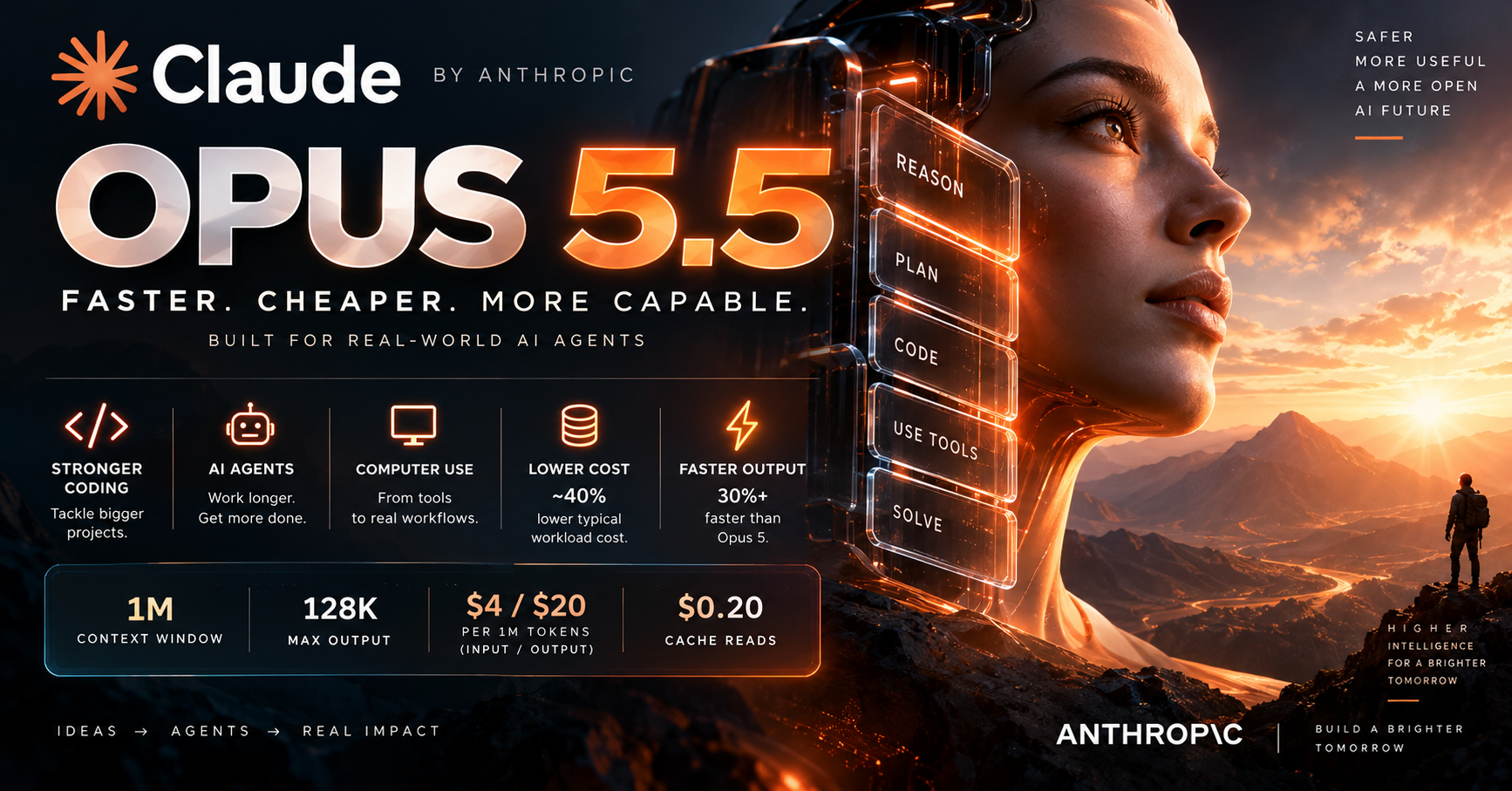
Claude Opus 5.5 Is Here: Faster, Cheaper and Built for Serious AI Agents
Anthropic has officially launched Claude Opus 5.5, the first model in its new Claude 5.5 family, with a clear focus on coding, long-running AI agents, professional research and complex knowledge work.
The new model arrived on September 22, 2026, and Anthropic is making a different kind of argument with this release.
Instead of simply making Claude larger or more expensive, the company says Opus 5.5 can complete difficult tasks more efficiently than Opus 5 while approaching the performance of the much more expensive Claude Fable 5.1 on many workloads.
Anthropic says typical workloads can cost around 40% less than Opus 5, while output generation is more than 30% faster.
That makes Opus 5.5 particularly interesting for developers building AI coding agents and other systems that may run for hours, consume millions of tokens and repeatedly work with the same large context.
What Is Claude Opus 5.5?
Claude Opus 5.5 is Anthropic’s latest high-end general-purpose model.
It is designed for tasks that require more than a quick response, including large software projects, research, business analysis, computer use and autonomous workflows involving multiple tools.
Anthropic says the model performs at roughly the level of Claude Fable 5.1 on most work, despite sitting in a cheaper pricing tier.
This is important because Fable 5.1 was introduced as Anthropic’s model for demanding reasoning and long-horizon agentic work.
With Opus 5.5, much of that capability appears to be moving into a model that is easier to justify for everyday production use.
Claude Opus 5.5 Specifications
Claude Opus 5.5 offers a 1 million-token context window, making it suitable for very large codebases, extensive documentation and long-running conversations.
It supports up to 128,000 output tokens.
The model accepts text and images as input and produces text output.
Adaptive thinking is always enabled, while developers can control reasoning effort depending on how difficult the task is.
Available effort levels include:
Low, Medium, High, XHigh and Max.
The model’s reliable knowledge cutoff is June 2026.
For developers, the API model ID is:
claude-opus-5-5
These specifications make Opus 5.5 particularly suitable for tasks where the model needs to keep a large amount of information available while continuing to reason over it for an extended period.
Coding Is One of the Biggest Improvements
Software engineering is at the center of Anthropic’s Opus 5.5 launch.
The company is increasingly moving away from the idea of AI as simple code autocomplete.
Instead, it wants Claude to work on entire engineering tasks.
That might involve understanding a large repository, investigating a problem, editing dozens of files, running tests, checking the results and continuing until the issue is resolved.
Anthropic says one early tester used Opus 5.5 to complete a migration involving roughly 680,000 lines of code in less than a day.
Another test involved auditing and repairing a codebase containing around 200,000 lines. Anthropic says Opus 5.5 finished the work in less than three hours, while Opus 5 took considerably longer and used significantly more tokens.
These are examples selected by Anthropic rather than independent scientific evaluations, so they should not be treated as a guarantee of how every project will perform.
They do, however, show what the model is designed for.
The goal is no longer simply:
“Write this function.”
It is increasingly:
“Take responsibility for this engineering task and finish it.”
Strong Agentic Coding Performance
Anthropic also published benchmark results focused on agentic coding.
On Terminal-Bench 4.0, Anthropic reports a score of 66.4% for Opus 5.5.
For comparison, Anthropic lists:
Claude Fable 5.1 at 55.8%
Claude Opus 5 at 52.3%
and GPT-6 Astra at 57.9%.
On FrontierCode v1.1 Main, Anthropic reports Opus 5.5 at 54.4%, ahead of Fable 5.1 in its evaluation.
The company also reports improvements on CursorBench, another evaluation focused on real software-engineering work.
These results suggest Opus 5.5 is especially strong when coding requires the model to keep working through multiple steps rather than simply answer an isolated programming question.
There is an important caveat.
These benchmark figures were published as part of Anthropic’s own launch materials. Different models may have been tested using different reasoning settings, environments or tool configurations.
They are useful indicators, but developers should still test the models on their own workloads.
Long-Running AI Agents Are a Major Focus
Perhaps the more important story behind Opus 5.5 is not coding itself.
It is persistence.
Modern AI agents may need to work for several hours, interact with tools, make repeated decisions and recover from mistakes without losing track of the original objective.
Anthropic says early users have tested Opus 5.5 on workflows spanning many hours and multiple repositories.
The company highlights improvements in the model’s ability to delegate work to subagents, verify its own output and maintain focus across complex projects.
These capabilities matter because long-running agents create problems that normal chatbots do not face.
An agent must remember what it has already tried.
It must understand why something failed.
It must know when to change approach.
And it must avoid repeatedly making the same mistake.
A model that is slightly smarter on an academic benchmark but constantly loses context during a real project may ultimately be less useful than one that can reliably finish the job.
Lower Pricing Changes the Opus Equation
One of the biggest changes is pricing.
Claude Opus 5.5 costs:
$4 per million input tokens
and
$20 per million output tokens
Opus 5 costs $5 per million input tokens and $25 per million output tokens.
That means Anthropic has reduced the basic token price by 20%.
But the company says the real reduction in typical workload cost is closer to 40% because Opus 5.5 also uses fewer tokens to complete many tasks.
That distinction matters.
Two AI models can have identical token prices while producing very different final bills.
If one model needs fewer attempts, fewer tool calls and less output to successfully finish a task, it may be cheaper even if the advertised token price looks similar.
That is why AI companies are increasingly talking about cost per completed task instead of only cost per million tokens.
Prompt Caching Is Much Cheaper
The cache pricing may be particularly important for AI agents.
Opus 5.5 cache reads cost:
$0.20 per million tokens
compared with:
$0.50 per million tokens for Opus 5.
That represents a 60% reduction.
Cache writes are also cheaper, falling from $6.25 to $5 per million tokens for the standard cache-write tier highlighted by Anthropic.
Why does this matter?
Imagine a coding agent working on a large repository.
The repository structure, documentation, system instructions and many source files may remain unchanged while the agent performs dozens of different actions.
Without caching, the system may repeatedly pay to process the same information.
Caching allows that context to be reused at a much lower price.
For agents working with hundreds of thousands of tokens over long sessions, this can become a major part of the final cost.
Opus 5.5 vs Claude Fable 5.1
The most interesting comparison may actually be inside Anthropic’s own model family.
Claude Fable 5.1 costs:
$10 per million input tokens
and
$50 per million output tokens.
Opus 5.5 costs:
$4 input
and
$20 output.
That makes Opus 5.5 60% cheaper on standard input and output token pricing.
Yet Anthropic says Opus 5.5 reaches Fable 5.1-level performance on much of its real-world work and exceeds Fable on several coding evaluations published with the launch.
That does not mean Fable 5.1 suddenly has no purpose.
Fable remains aimed at especially demanding reasoning and long-horizon workloads.
But many developers who previously considered using Fable for difficult coding tasks may now find that Opus 5.5 provides a better balance between capability and cost.
Opus 5.5 vs GPT-6 Astra
OpenAI’s GPT-6 Astra remains one of the most important competitors at the high end of the market.
Astra costs:
$10 per million standard input tokens
and
$50 per million output tokens.
That puts it in roughly the same raw pricing class as Claude Fable 5.1 rather than Opus 5.5.
Opus 5.5, at $4/$20, is considerably cheaper on raw token pricing.
Anthropic also reports Opus 5.5 ahead of Astra on some agentic coding evaluations, including Terminal-Bench 4.0.
But Astra remains highly competitive in areas such as scientific agents, computer use and difficult end-to-end workflows.
The important point is that no single benchmark tells developers which model will be cheaper or more reliable for their application.
A model that costs more per token may still finish a task using fewer tokens.
Another model may be cheaper but require additional retries.
Real-world evaluation remains essential.
GPT-6 Sol Creates Another Competitor
The market changed again on the same day Opus 5.5 launched.
OpenAI also introduced GPT-6 Sol, a lower-cost member of the GPT-6 family.
GPT-6 Sol costs:
$2 per million input tokens
and
$10 per million output tokens.
That is exactly half the standard token price of Opus 5.5.
This makes Sol a potentially important competitor for developers who want strong coding and agent capabilities but do not need Astra-level performance.
The comparison between Opus 5.5 and GPT-6 Sol may therefore become more relevant for many production applications than Opus versus Astra.
Opus currently carries the higher raw API price, while Anthropic is emphasizing its efficiency and ability to complete agentic tasks using fewer steps and tokens.
Again, the winner may depend more on the workload than the price sheet.
Faster Output
Anthropic says Opus 5.5 generates output more than 30% faster than Opus 5.
There is also a Fast mode available for customers who need even lower latency.
Fast mode can provide up to approximately 2.5 times normal speed, according to Anthropic.
The tradeoff is price.
Fast mode costs:
$8 per million input tokens
and
$40 per million output tokens.
This allows developers to choose between lower-cost background processing and faster interactive experiences.
A coding agent running overnight may not need Fast mode.
An interactive development assistant where the user is waiting for every response might benefit from it.
Better Knowledge Work
Anthropic is not positioning Opus 5.5 as a coding-only model.
The company also reports strong results in professional research and knowledge work.
This includes tasks involving large-scale data collection, business analysis, document research and professional reporting.
The underlying pattern is similar to coding.
Anthropic is trying to make Claude better at completing an entire workflow rather than producing one isolated response.
A research agent might search for information, compare multiple sources, run calculations, inspect documents and then produce a finished report.
The ability to maintain context and use tools reliably becomes just as important as raw question-answering ability.
Better Computer Use
Computer interaction is another area Anthropic says has improved.
This matters because not every useful business application provides a clean API.
Sometimes an AI agent needs to interact with the same graphical software that a human uses.
That can include internal dashboards, browsers, development tools and other desktop applications.
Improved computer-use capabilities could therefore allow Claude agents to automate workflows that previously required custom software integrations.
Safety Matters More as Agents Become More Autonomous
More capable agents also create additional risks.
An AI system that only produces text has limited ability to affect external systems directly.
An agent capable of editing code, executing commands and interacting with software has much greater responsibility.
Anthropic says Opus 5.5 performed better than previous models on its internal behavioral evaluations and is less likely to take difficult-to-reverse actions or operate outside the boundaries of its assigned task.
The company also says the model has stronger resistance to prompt-injection attacks.
Opus 5.5 was tested before release by external evaluators including METR and Frontier Design.
That does not mean agent failures have been solved.
Anthropic itself acknowledges that highly capable models still have limitations.
But safety evaluation is increasingly becoming part of the product itself rather than something separate from model performance.
Availability
Claude Opus 5.5 is available through Anthropic’s Claude Platform using:
claude-opus-5-5
It is also available through major cloud providers, including:
Amazon Web Services
Google Cloud
and Microsoft Azure.
Amazon Bedrock lists the model as active with a September 22, 2026 launch date.
Anthropic has also confirmed that Claude Sonnet 5.5 and Claude Haiku 5.5 are planned for the coming weeks.
Those releases may ultimately be important for developers who need lower-cost models for much higher-volume applications.
Who Should Use Claude Opus 5.5?
Opus 5.5 appears particularly well suited for:
Large software projects.
Long-running coding agents.
Repository-wide debugging and migrations.
Professional research.
Business analysis.
Multi-step autonomous workflows.
Computer-use agents.
Tasks that repeatedly reuse large amounts of cached context.
For very simple summarization or high-volume classification, using a smaller model may still make more economic sense.
Final Thoughts
Claude Opus 5.5 may be one of Anthropic’s most practical frontier-model releases so far.
The interesting part is not simply that benchmark scores increased.
Anthropic has simultaneously lowered token prices, dramatically reduced cache-read costs, increased output speed and improved the model’s efficiency on long-running tasks.
That combination reflects where the AI industry is heading.
The competition is moving beyond:
“Which model is smartest?”
Developers increasingly want to know:
Which model can reliably finish the most useful work for the least money, time and human intervention?
Opus 5.5 is Anthropic’s latest answer.
And with GPT-6 Astra targeting maximum capability, GPT-6 Sol pushing prices lower and Fable 5.1 remaining available for demanding long-horizon reasoning, developers now have more meaningful choices than ever.
The best model will increasingly depend not on a single leaderboard score, but on the work you actually need it to finish.