Google Gemini 4 Argon Is Here: Features, Benchmarks, Pricing and How It Compares to GPT-6 and Claude
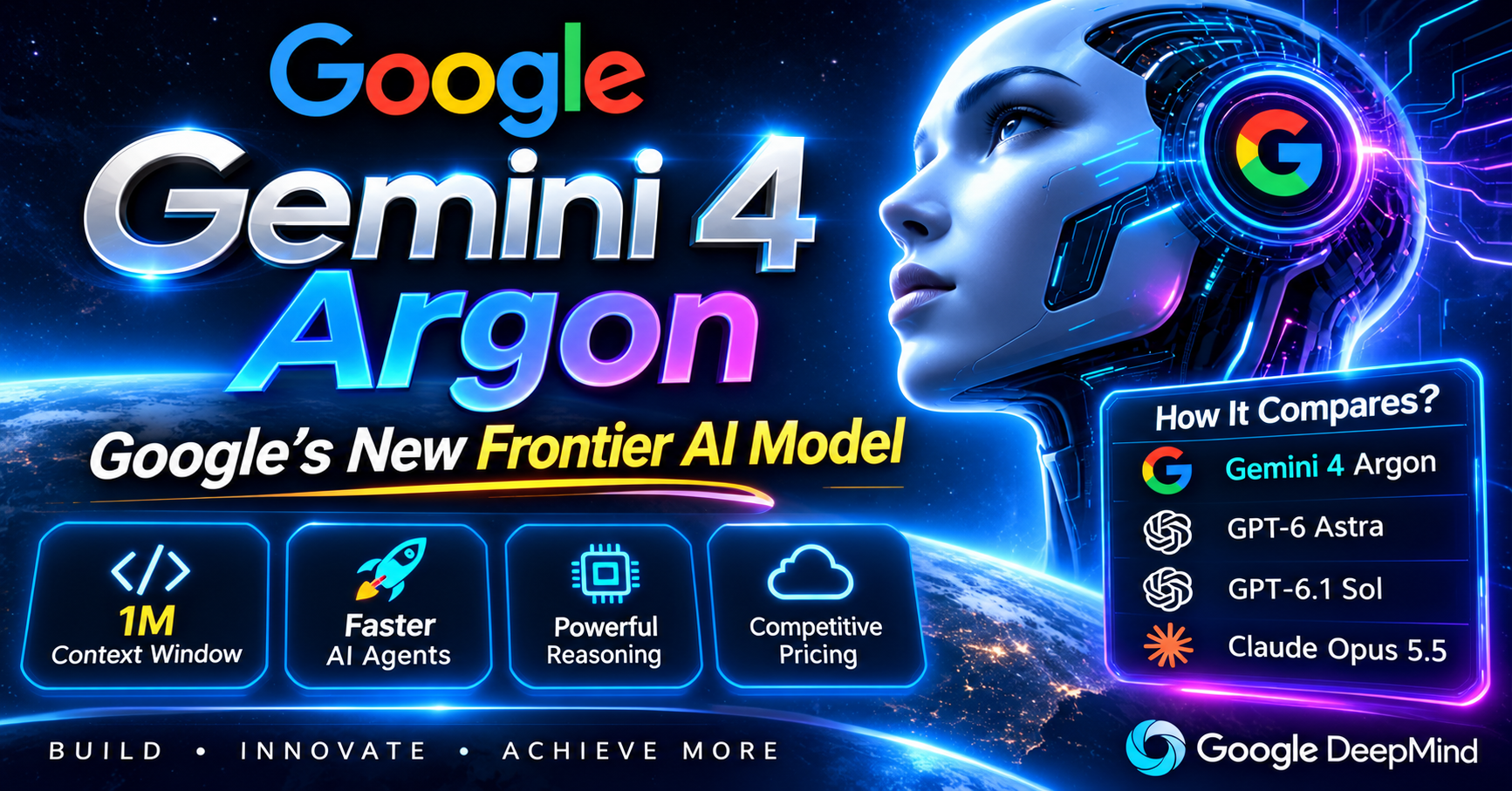
Google has officially released Gemini 4 Argon, its new flagship AI model, bringing major improvements in coding, long-running AI agents, scientific reasoning, cybersecurity defense and complex business workflows.
Launched on October 13, 2026, Argon marks the beginning of a new generation of Gemini models. Rather than focusing on faster chatbot responses, Google is targeting something considerably more ambitious: AI systems that can take on difficult assignments, work through multiple stages and produce useful results with less human intervention.
The timing is particularly interesting.
OpenAI has been expanding its GPT-6 family, including the powerful GPT-6 Astra and the more affordable GPT-6.1 Sol. Anthropic, meanwhile, has strengthened its Claude lineup with Opus 5.5 and Fable 5.1.
Now Google is entering that competition with a model that combines frontier-level reasoning, extensive multimodal capabilities and an aggressive introductory API price.
But how powerful is Gemini 4 Argon, and where does it actually stand against its competitors?
What Is Gemini 4 Argon?
Gemini 4 Argon is Google’s latest frontier reasoning model, developed by Google DeepMind for tasks requiring sustained intelligence and accurate execution.
It is designed to handle complex software engineering, financial analysis, legal research, scientific problem-solving and autonomous workflows involving multiple tools.
The model can analyze large collections of information, maintain context across lengthy tasks and use external tools to complete work that might otherwise require several separate applications.
This represents a broader change in the AI industry.
A conventional chatbot waits for a question and produces an answer.
An autonomous AI agent can receive an objective, investigate the problem, use tools, review its own progress and continue working until it reaches a result.
Gemini 4 Argon is built with that second approach in mind.
Google describes the model as particularly capable in situations where reasoning, precision and persistence matter more than simply generating an immediate response.
Gemini 4 Argon Specifications
One of Argon’s most interesting features is its unusually flexible context and output capacity.
According to Google’s official developer documentation, the model supports a unified context window of 1,048,576 tokens.
Unlike systems with completely separate input and output allowances, Gemini 4 Argon operates within a shared token budget.
By default, synchronous responses support up to 65,536 output tokens.
However, developers can use long-decode capabilities to generate much longer responses, potentially approaching one million output tokens when the input and remaining context budget allow it.
This requires background execution for outputs exceeding the standard synchronous limit.
Key Specifications
| Feature | Gemini 4 Argon |
|---|---|
| Release date | October 13, 2026 |
| Model ID | gemini-4-argon |
| Context window | 1,048,576 tokens, shared |
| Standard maximum output | 65,536 tokens |
| Long-decode output | Up to the shared 1M-token limit |
| Inputs | Text, images, video, audio and PDF |
| Output | Text |
| Reasoning levels | Low, Medium, High |
| Function calling | Supported |
| Code execution | Supported |
| Computer use | Preview |
| Search grounding | Supported |
| Prompt caching | Implicit caching |
| Knowledge cutoff | March 2026 |
The model also supports structured outputs, URL context, file search and Google Maps grounding.
Native image generation and audio generation are not supported by this particular model.
These capabilities make Argon suitable for much more than conversational AI.
Long-Running AI Agents Are the Main Focus
One of the biggest limitations of current AI agents is maintaining reliable performance during lengthy assignments.
A model might perform well on the first few steps but gradually lose track of earlier decisions, forget requirements or repeatedly attempt approaches that have already failed.
Google is specifically targeting those problems with Gemini 4 Argon.
The model is designed for workflows involving planning, tool use, repeated evaluation and multi-step execution.
An AI agent powered by Argon could, for example, examine a software repository, identify a problem, modify relevant files, execute tests and review the results.
A business agent could analyze several financial documents, extract relevant numbers, compare them and prepare a structured report.
The important distinction is that these tasks involve more than producing text.
They require the model to maintain a coherent objective across multiple operations.
Google says early enterprise testers have seen meaningful improvements in this area, particularly when workflows require substantial reasoning and long-term context.
Coding Performance: A Serious Challenger to GPT-6 Astra
Coding is one of the clearest strengths of Gemini 4 Argon.
Google has positioned the model for complex software development rather than basic code completion.
Its intended tasks include large repository analysis, debugging, automated testing, software migrations, performance optimization and multi-file development.
Google’s published benchmark results place Argon among the leading models for agentic software engineering.
On DeepSWE v1.1, Gemini 4 Argon achieved 77.9%, compared with 74.1% for GPT-6 Astra and 74.2% for Claude Opus 5.5 in Google’s evaluation table.
That is an impressive result.
However, the picture changes on other benchmarks.
On Terminal-Bench 4.0, Gemini 4 Argon scored 57.4%, while Claude Opus 5.5 reached 66.4% and GPT-6 Astra reached 58.2%.
On FrontierSWE v2, GPT-6 Astra also remained ahead.
This is an important reminder that no single benchmark establishes which AI model is best at software engineering.
Different evaluations measure different skills, and performance can change depending on the tools, settings and development environment.
Still, Argon’s performance suggests Google is increasingly competitive in the coding-agent market.
Google Is Already Using Argon on Large Codebases
Google has shared several internal examples demonstrating what Gemini 4 Argon can do.
One of the most interesting involves Chromium, the open-source project behind Google Chrome.
The Chrome team used Argon to help restructure legacy browser code across hundreds of files.
According to Google, the work involved a major architectural refactor inside Chromium’s approximately 40-million-line codebase.
The company says work that could have taken months was completed in weeks.
Another example comes from Google’s open-source Agent Development Kit.
Argon worked on performance improvements while operating within automated testing constraints.
Google reports that the resulting changes reduced in-memory session preparation time by 40% during long sessions and improved cold import performance by 21%.
These are Google-reported examples rather than independently controlled benchmarks.
Nevertheless, they demonstrate something important about the direction of AI-assisted development.
The goal is moving from generating small pieces of code to improving existing production software.
Gemini 4 Argon Can Generate Extremely Long Outputs
A particularly unusual addition is Argon’s long-decode capability.
Most AI models impose relatively modest limits on the amount of content that can be generated in a single response.
Gemini 4 Argon supports much longer output sequences through background execution.
In suitable workflows, developers can generate extensive code, long technical documents or complex mathematical derivations without splitting the output into numerous smaller requests.
Google highlights potential applications including full-repository code generation, multi-file application development and advanced scientific reasoning.
There is an important technical limitation: the input and output still share the same overall context budget.
A one-million-token output is therefore not available alongside another one million tokens of input.
Actual results also depend on reasoning-token consumption and the task being performed.
Even with these limitations, the extended output capability is an interesting differentiator.
Business Automation and Professional Work
Google is putting considerable emphasis on enterprise applications.
Argon is designed to process complex financial documents, legal materials, business records and data-heavy reports.
Unlike a simple document summarizer, it can combine information from different formats, including tables, charts, images and written text.
Google reports strong results across several professional evaluations.
On the Vals Index, a benchmark covering economically valuable professional tasks, Gemini 4 Argon scored 68.9%.
The same Google-published comparison lists Claude Opus 5.5 at 67.0% and GPT-6 Astra at 63.1%.
On Vals Finance Agent v2, Argon reached 65.4%, ahead of the competing models included in Google’s comparison.
The model also performed strongly on Harvey’s Legal Agent Benchmark, although its 19.6% score shows that difficult legal-agent evaluations remain far from solved.
For businesses, this points toward applications such as financial reconciliation, contract analysis, compliance research, executive reporting and enterprise data processing.
Human review remains essential for consequential financial and legal decisions.
Scientific Research Is Another Major Focus
Gemini 4 Argon is not limited to business automation and programming.
Google DeepMind has also demonstrated applications in mathematics, computational biology, chemistry and scientific software.
One example involves xTB, an open-source computational chemistry package used to investigate molecular structures.
Google researchers used Argon to improve parts of the software, reporting performance improvements of up to 2.3 times for molecular structure prediction and 1.8 times for conformer searching.
In another project, Argon helped optimize code used in Google’s Gemma model ecosystem.
These examples suggest that advanced AI models are becoming increasingly useful as research assistants capable of working directly with scientific software.
Instead of only explaining a scientific concept, they can help improve the computational tools researchers depend on.
Google has also demonstrated robotics applications, including using video observations to help construct simulations of physical tasks.
These remain research demonstrations, not evidence that autonomous AI can reliably perform any scientific or physical task.
But they illustrate the direction Google is pursuing.
Gemini 4 Argon and Cybersecurity
Cybersecurity is another major area of development.
Google says Gemini 4 Argon delivers advanced defensive capabilities while maintaining restrictions on potentially harmful security-related requests.
On CWE-Bench v1, Argon achieved a reported score of 68%, tying the highest result in Google’s published comparison.
The benchmark evaluates the ability to remediate software vulnerabilities.
Google has also highlighted improvements in resistance to indirect prompt-injection attacks, where untrusted documents or web content attempt to influence an AI system’s behavior.
That matters for autonomous agents because they frequently encounter external information while completing tasks.
An attacker might attempt to manipulate an agent through content it reads, even when the agent’s original user instructions are legitimate.
Google says Argon has stronger protections against this category of attack than its earlier models.
The company also maintains restricted cybersecurity access through its Fairwind Program for vetted defensive-security organizations.
For normal developers, the standard model supports legitimate defensive tasks such as secure code review and vulnerability remediation.
Gemini 4 Argon Pricing
Pricing is one of the most competitive parts of Google’s announcement.
The company has introduced Gemini 4 Argon at:
$2 per million input tokens
$10 per million output tokens
These introductory rates are available through November 30, 2026.
Beginning December 1, 2026, the standard pricing will increase to:
$4 per million input tokens
$20 per million output tokens
Google also offers automatic implicit prompt caching.
When cached content is reused successfully, eligible cached input receives a 95% discount.
This reduces the introductory cached-input price to approximately $0.10 per million tokens, increasing to $0.20 under standard pricing.
Unlike some previous Gemini models, Argon does not support explicit cache creation through the API.
For applications using large recurring contexts, that distinction matters.
The actual cost of an agent also depends on reasoning tokens, execution time, tool usage and the number of retries required to finish a task.
Gemini 4 Argon vs GPT-6 Astra, GPT-6.1 Sol and Claude Opus 5.5
Google is competing against two different types of frontier models.
The first group prioritizes maximum capability, even at a higher inference cost.
The second tries to provide strong performance at a price suitable for frequent production use.
Gemini 4 Argon sits between these approaches.
API Pricing Comparison
| Model | Input / 1M Tokens | Output / 1M Tokens |
|---|---|---|
| Gemini 4 Argon (introductory) | $2 | $10 |
| GPT-6.1 Sol | $2 | $10 |
| Claude Opus 5.5 | $4 | $20 |
| GPT-6 Astra | $10 | $50 |
Gemini 4 Argon’s introductory pricing ends November 30, 2026. Other prices represent published standard short-context token rates and exclude special processing tiers.
At launch, Gemini 4 Argon matches GPT-6.1 Sol on headline token pricing.
It is also substantially cheaper than GPT-6 Astra.
Compared with Claude Opus 5.5, Argon’s introductory prices are half as high.
However, price alone is not enough to determine which model provides the best value.
A more expensive model may complete certain assignments using fewer retries or less overall computation.
Likewise, a cheaper model may achieve comparable results on tasks where the most advanced reasoning capabilities are unnecessary.
Selected Benchmark Comparison
Google DeepMind published the following results:
| Benchmark | Gemini 4 Argon | GPT-6 Astra | Claude Opus 5.5 |
|---|---|---|---|
| DeepSWE v1.1 | 77.9% | 74.1% | 74.2% |
| Terminal-Bench 4.0 | 57.4% | 58.2% | 66.4% |
| Vals Index | 68.9% | 63.1% | 67.0% |
| AutomationBench | 51.3% | 41.4% | 42.5% |
| FrontierSWE v2 | 55.0% | 65.5% | 62.3% |
| CWE-Bench v1 | 68.0% | 68.0% | 67.0% |
These results come from Google DeepMind’s published evaluations and should not be mistaken for a single, independently administered competition under identical conditions.
They show a mixed but interesting picture.
Gemini 4 Argon performs particularly well in several long-horizon coding, automation and professional-work evaluations.
Claude Opus 5.5 remains stronger on Terminal-Bench 4.0, while GPT-6 Astra leads on FrontierSWE v2.
The best model will depend on the tasks developers actually need to complete.
Is Gemini 4 Argon Better Than Gemini 3.8 Flash?
Gemini 3.8 Flash remains relevant, even with Argon’s arrival.
Flash was built around a different economic target: strong reasoning and agent capabilities at a lower cost.
Argon is Google’s more capable flagship model for demanding work.
That makes the choice relatively straightforward.
For simple automation, content processing and high-volume applications, Gemini 3.8 Flash may remain the more economical option.
For difficult coding projects, large technical investigations, complex research or professional workflows where additional reasoning can materially improve results, Argon deserves consideration.
The most sensible approach is to test both models against the same workload.
Where Can Developers Use Gemini 4 Argon?
Google has made the model available through several products and platforms.
Developers can access Gemini 4 Argon through the paid Gemini API, Google AI Studio and Google Antigravity.
The model identifier is:
gemini-4-argon
Businesses can also use it through Google’s enterprise AI offerings.
For consumer users, Google has announced availability in the Gemini app for Google AI Pro and Ultra subscribers.
Availability in a paid consumer subscription does not mean the model is included in the Gemini API’s free tier.
API usage has its own pricing and access requirements.
Should Developers Switch to Gemini 4 Argon?
The answer depends on the application.
Argon looks especially promising for developers working on complex coding projects, large repositories, advanced reasoning problems and long-running agents.
Its extended output capability may also be attractive for systems that need to generate large technical artifacts.
However, there are reasons to test carefully before migrating.
Long-running reasoning can increase latency.
Some workloads may encounter timeouts.
And the introductory pricing will increase in December.
For production applications, developers should compare successful task completion, latency, retries, total token usage, tool reliability and final cost.
A strong benchmark result is useful.
A model that reliably completes your specific workload is far more valuable.
Final Thoughts
Gemini 4 Argon is a significant release for Google DeepMind.
Its combination of strong reasoning, multimodal input, long-horizon agent capabilities and extended output support makes it an important addition to the frontier AI market.
Google is also backing its claims with examples from real software engineering, enterprise research and scientific computing projects.
But the competition is far from settled.
OpenAI continues to develop the GPT-6 family, while Anthropic’s Claude models remain particularly strong in coding and agentic workflows.
What makes Gemini 4 Argon interesting is not that it wins every benchmark.
It doesn’t.
The more meaningful development is that Google is offering another serious option for developers who want AI systems capable of completing substantial work rather than simply answering questions.
The next stage of AI competition will increasingly depend on how reliably these models can plan, use tools, adapt to unexpected problems and finish real assignments.
Gemini 4 Argon is Google’s latest attempt to lead that transition.